Saturday, May 4, 2013

Spring is flying...

Today is May 4th.  Amanda turned 24 yesterday and left this morning on a 3-day tour of some of the not-so-distant highlights of Romania with her father.  He is our third visitor for the spring.  With visitors, conferences, teaching, bookbinding, and other fun activities, the past 2 months have flown by and my blog has been dormant.  I regularly write to this blog in my mind when I am walking.  I observe and reflect when I am walking - it is a very good time for thinking - and so I am often coming up with things to share with my readers of this blog.  It is unfortunate, I do not have a way yet to take my thoughts and download them to the computer...

In lieu of that, I will spend a little time today posting pictures and a few thoughts and commentary for those who might not have given up on me.  Here we are last night at the Harbor restaurant celebrating Amanda's 24th birthday...


Spring has been arriving in full color since early April...


The following are a few of the sights as I have been walking around Bucharest this spring...


This last picture is of a demonstration protesting the sudden closing of a factory along with failure to pay the workers...

Okay, now to a few subject-oriented blog posts...

Sunday, March 17, 2013

On Language and Recent Activities

I am genuinely grateful to have been born and raised in a country where the language is the one adopted as the "International Language".  I do not mean that statement in any light or facetious manner.  I feel grateful that I am lucky enough to come to another country and get by with the 60-100 word vocabulary that I have in Romanian.  I know enough to exchange pleasantries, to make purchases, to order restaurant meals, and to give instructions to the taxi driver.  Beyond that I must use English.  I am confident that if no one spoke English here my vocabulary would be bigger than it is, but I am lucky that I haven't had to learn.  I want anyone who reads this blog to know that I understand and accept this as a fortunate occurrence   Lots of people the world over must learn at least one if not more languages than their first in order to get along.

What has me thinking about this degree of accommodation I am lucky to receive is the film festival Amanda and I have attended this week.  One World Romania is an international human rights documentary film festival that ended today.  When I initially became aware of the festival I did not pay much attention as I assumed the films would be either in Romanian or subtitled in Romanian when in other languages. They were subtitled in Romanian, but below and secondarily to the English subtitling...

At the beginning of the week I was asked by the director of Invingem Autismul, the center where Amanda volunteers if I would join her as a speaker following a documentary on a young Russian man with autism. She assured me the film would have English subtitles and so I agreed.  Anton's Right Here (click on arrow to the right of the film title for a trailer) was a powerful depiction of the huge difference that environment makes in anyone's - but in this case especially in Anton's - ability to be successful in the world.  When Anton was in a neuropsychiatric hospital where the doctors stated there is no such diagnosis as autism in Russia and where there was significant understaffing, he regressed in all ways.  When he was taken to a farm with one on one assistance, he quickly rose to the challenge of being a productive member of the community.  Both Amanda and I were able to add reactions and point out differences between Russian, Romanian, and American options for treating autism.  It was great to be able to contribute in that way.

Because we went to the one film, we looked at the program and found 3 others we thought we might be interested in.  While all were listed as having English subtitles, the one that was actually in English did not - unfortunate for Amanda who relies on reading captions to understand dialogue in films and on TV.  Two of the films, Little World and Planet of Snail (click here to access trailers) focused on the Abilities of people often thought of as being DIS-abled.  Both were worthy reminders that we are all of us limited more by our own perceptions of what can and cannot be done than by anything else.  Both also focused on how the right kinds of support from the people around can make a world of difference.

Amanda and I were able to enjoy these films because we are lucky enough to have English as our first language, the language of the subtitles, and also because we have learned enough in our living here to find the theatres, buy tickets, and relax!

Thursday, March 7, 2013

Amanda the Film-maker

This blog is mostly about me and my experiences here in Bucharest and elsewhere as we travel, but sometimes a mom has to brag and show off her child...


When I was preparing to come here last year, I was often asked, "But what will Amanda do while you are working?"  My response was typically some version of, "She'll do exactly what she does here at home.  She'll attend classes, she will write on her screenplays and novels, and she will explore the city."  While my statement has held up, the truth is even better!  As I have posted previously, Amanda has also been an active volunteer at Autismul Invingem, an Applied Behavior Analysis center for children with autism.  She completed one online class from our community college in the fall and is in process of completing two additional online classes.  She is also taking an in-person class, with Romanian students, in Cross-Cultural Management (taught in English) at a local university.  And she has actively been continuing her budding film career.

Last summer, prior to our coming to Romania, Amanda completed a 5-week program at UNC-School of the Arts in film-making.   As part of that experience - a wonderful one, I might add - she produced a film called Sweet Tooth, that she wrote and directed.  Shortly afterwards she attended the Gideon Film Festival in Black Mountain, NC.  There she learned additional skills and networked with people who assisted her in shooting her second film, Flowers for Sale.  Among these people were Irene Santiago and her daughter, Ariana Baron, both film professionals.  (For further information about Amanda's films, including viewing Sweet Tooth, see her website: http://www.retromurrayfilms.com.)

While we have been in Romania, Amanda been actively forwarding her film-making activities.  In addition to continuing her writing on other scripts, she has improved her website and has collaborated with Ellen Hendrix, a professional film editor who edited Flowers for Sale.  Now the film is ready for entry to film festivals.  Amanda has set up a site requesting micro-financing assistance: http://www.gofundme.com/28dp30.  I leave it to you, dear reader, whether this is a good use of your own funds.
(after a show on board the cruise we did)

Saturday, March 2, 2013

March 1

March 1 in Romania is a wonderful celebration of the coming of spring.  Here in Bucharest, I started noticing the red and white colors and the trinkets (martisoara) for sale about the middle of February.  (Amanda and I each had received from our Bulgarian host, David, a symbol of the celebration when we were there.)

But I think the holiday really began for me when Karen sent an email saying she had seen something that reminded her of me and so she had a small spring gift for me...  Before I could collect however, I had tea with a former student, Corina, and I asked her to explain the significance.  As I understand it, tradition held that boys would tie a red & white string around the wrist of a sweetheart on March 1. As long as the string stayed on through the end of March, they would be lucky in love.  Of course as these things do, the symbolism and the celebration grew.  Now, many trinkets can be purchased - from cheap manufactured things to lovely hand-made items - and they can be given to almost anyone as a symbol of luck in the coming season or year. Typically males give these to females, females give them to one another, but females do not give them to males.  Parents might give them to the teachers of their children, one might give them to the doctor, hairdresser, grocer, etc - whomever one happens to visit on March 1.  The red and white colors symbolize the contrast between cold and warm weather, death of winter and new life of spring, old and new...  One of my former students sent me a virtual martisor, sending the picture below in an email:
I finally met up with Karen, and also with David, on Thursday Feb 28.  We went to see a church so that I could photograph its amazing door (a detail from which is shown below) for my Romanian Doors book, then went to lunch at an Italian restaurant Karen had discovered and wanted to share with us.

There she gave me a little handmade leather bound book!  Definitely perfect for me!  We then went to Piata Romana, where she had found the little books and I was able to get some to share with others.
I enjoyed talking with Daniel, who makes his own paper and binds larger journals as well as these little ones.     I plan to follow up with him and learn more about what he is doing in terms of papermaking and binding.  I also enjoyed talking with Radu who paints small pictures and kitchen items for sale at this time of year.
And then I headed home to share with Amanda what I had seen and learned.  She went to the autism center on Friday with several bracelets she had picked out to share with the girls she has come to know there.  And she came home with several trinkets and a small bunch of flowers as well.
We then went to the March fair at the peasant museum, where the selection of martisoara was amazing!  And here it was all handmade items!  Mostly in the form of small trinkets, but ranging to large and expensive items.  Here is a sample of items I selected (which will wait until I get home to be given away, but they will still carry wishes for good luck):
 Petre, the man who carves these small items, is a retired art teacher.
 These small books are fun, but not as well crafted as the ones above that Daniel made.  But, I really like the creativity that Alexandra puts into her large journals.  She had one that used part of an LP record for its cover and one that had a collage of old postcards on its cover.
I also met a third bookbinder, Ioana, who does lovely embroidery on the front of her books:
So not only have I celebrated a new - to me - holiday, but I have had the opportunity to visit with a number of craftspeople and have learned that there are several folks doing bookbinding in this city.

Here is a brief article with more information about the tradition of martisor.

Happy March 1 to all of you!


Monday, February 25, 2013

Mediterranean Adventure - Part 4 (Istanbul)

                                 
The ship docked in Istanbul at about 1:00 pm on Monday and departed 8:00 pm the following day.  Knowing that we had extended time and given the many sights and activities that interested the two of us, I decided to splurge on a private guide.  A most excellent decision!  Burcu Tokgaz was pleasant and knowledgable; she paid attention to what I had communicated both ahead of time via email and also once we met, so had a good idea of what interested us and how to interact with Amanda.  We were much more efficient as a result – moving from one activity to another was almost seamless and I am certain our experience was much richer as a result.  Amanda said it was like seeing Istanbul with a friend.

Burcu met us at the port as we disembarked from the ship.  We immediately took the tram to the Blue Mosque. We were hurrying a bit to get in between prayer times. The artwork is amazing and it was good to talk a little about Turkish Muslim traditions.  We were verbally pushed out the door when it was time for afternoon prayer.  Burcu pointed out that prayer times are determined by sunrise and sunset, so in the winter they are much closer together than in the summer.

Walking to the Blue Mosque, Amanda met the first of many Istanbul friends.  It turned out that Burcu was also an animal lover...

Both pictures above are of the Blue Mosque (details of which can be found here: http://www.bluemosque.co/, along with some lovely pictures)

We then moved on to Tokapi Palace, where is was very crowded since it would be closed to visitors the following day.  Again, we had to hurry and hustle a bit in order to see the parts that Burcu deemed most significant.  It was very clear we would have spent the greater part of our time waiting in lines had it not been for her licensed tour guide badge and her knowledge of the place.  While I remain skeptical of the literal accuracy, I was still impressed by the religious relics on display, the staff of Moses and David’s sword among them.  We concluded our time at the palace with a visit to the museum shop – Amanda looked at lots of jewelry and so this took a while.

 a short respite prior to going to the Museum shop - Burcu is seated with Amanda.

For the last task of Monday, Burcu delivered us to Les Arts Turcs II (http://www.lesartsturcs.com/), where I met Ali & Betul for my marbling lesson.  It was helpful again having Burcu for the transition. They were so very hospitable – feeding Amanda and providing her with Internet access while I was doing the class session. (They were also very generous in presenting her with one of their handmade tiles at the end of the evening, as a "reward for her patience".)  And they even drove us back to ship at the end. I loved, loved, loved my time with Betul and Ali as I learned Ebru marbling (and have shown pictures in the previous post).  Betul's method of teaching was to demonstrate the technique for each of several designs: tulip, daisies, rose, chrysanthemum, tree and then have me try to copy.  

Tuesday, our second day, we met Burcu a little later than 9 am and walked to the Dolmabahce palace (http://www.dolmabahcepalace.com), the administrative center of the Ottoman Empire at its end, and also used by Ataturk during the early years of the Republic.  I enjoyed this one much more than Topkapi, mostly because we were seeing living areas with furniture rather than exhibits.


From the palace we took a tram to Hagia Sophia (pronounced "eye-ya"; http://www.hagiasophia.com/). The building was first an early Christian church.  When it became a mosque in the mid-1400s, the Muslims painted over the Christian mosaics, but did not destroy them. The building is now a museum with the artwork of both religious traditions visible.  Unfortunately Amanda had an unpleasant reaction to Hagia Sophia.  She enjoyed seeing the beautiful early mosaics depicting Jesus, Mary, and angels, and appreciated the architecture and even the Muslim calligraphy and decorative elements, but did not like that it had been turned into a museum.  To her this felt like desecration.  The final straw was when Burcu asked if she wanted to make a wish – I never did learn the source of this tradition, but saw there was a line at some element.  Amanda felt this was truly desecration in that neither Christians nor Muslims would believe in wishing… So Amanda needed to leave abruptly. She went out with Burcu while I went upstairs and saw mosaics and close-up pictures of mosaics.


Above and below are my pictures of close-up pictures that were on display.  My little camera is not powerful enough to capture the mosaics this well.  (In the picture above this one, you get an idea of the height - this depiction of Mary is in the top center.)


We then returned to Ali & Betul to pick up my now-dry marbling and to purchase a few additional items.

I purchased Betul's casebound book partly because I very much like the paper cut-out pasted on top of the marbling.  She sells her works through Etsy, if anyone of my readers is interested.

I especially liked Burcu's choice for lunch – Caferaga Medresesi (Community Art CafĂ©, http://www.tkhv.org/), an art/craft school where we had a private room with artwork to enjoy and an excellent traditional Turkish meal.  Notice Amanda and Burcu walking arm in arm down the narrow entryway - I would never have found this place.
Amanda had “Turkish ravioli”, filled with chicken and a having a yogurt based sauce – she not only said it was delicious, but had 2 servings!  Burcu and I both had the same food (she also is vegetarian): lentil soup followed by an egg & peppers dish (a little similar to a scrambled omelet) followed by stuffed vegetables that were a bit spicy hot, but not burning - just a comfortable flavor that let me know it was there.  The staff were  wonderfully attentive and the manager treated us to halva for dessert, which we all shared.
 Our next-to-last tourist stop of the day was the Basilica Cistern (http://en.wikipedia.org/wiki/Basilica_Cistern), the largest of many cisterns (water collection devices) the Romans built under Istanbul. It is much bigger and more impressive than I’d imagined and could have been a very short visit, but we took time to dress up and get posed photos taken.

Above, one small part of this cavernous cistern.  Below, Roman recycling: the head of Medussa, originally a decorative element on top of a column, is now upside down and services as a column's support (and would have been submerged when the cistern was full).

And, finally, much to Amanda's pleasure, on to the Grand Bazaar, where there are in excess of 4000 vendors along labyrinthine passageways.  Here again it was very helpful to have Burcu’s contacts and knowledge.  Amanda wanted jewelry and scarf and obtained both in pleasant relaxing situations.  Presumably we paid reasonable prices, we enjoyed social cups of tea with proprietors and were able to sit, as well as visit just a little – most pleasant interactions!  Amanda now has a lovely Turkish silk scarf and a necklace that is just right.

At 6:30 Burcu delivered us to the ship and we said our good-byes.

Sunday, February 24, 2013

Paper arts in Europe

I have been reading a most informative and interesting book on the history of paper making by Dard Hunter. I appreciate the opportunity to make connections between my own paper making experiences and the techniques and vocabulary provided in the book. Hunter wrote the book in the late 30s/early 40s. It is a most thorough and scholarly work.
Reading it has also provided context for my paper experiences here in Europe.
Roberto Mannino in Rome makes beautiful paper.  (His website is http://www.robertomannino.it/, where you can learn a little about him and view his sculpture work, that I also was able to view up close.)  He has a Hollander beater and orders pulp and fibers from Carriage House in the US - one of the same places I use. I suspect that part of the purchase price I paid for his paper included shipping costs that I do not have. 

Some papers that I purchased from Roberto:
                        
 The top pile of smaller sheets are sheets made of abaca and bamboo fibers.  I am turning them into a book of their own.
 He uses cotton, flax, abaca, and other plant materials for most of his paper and has a good eye for color and texture in his paper.  His sheets are well formed as well.  It was hard to decide among them for what I would purchase.
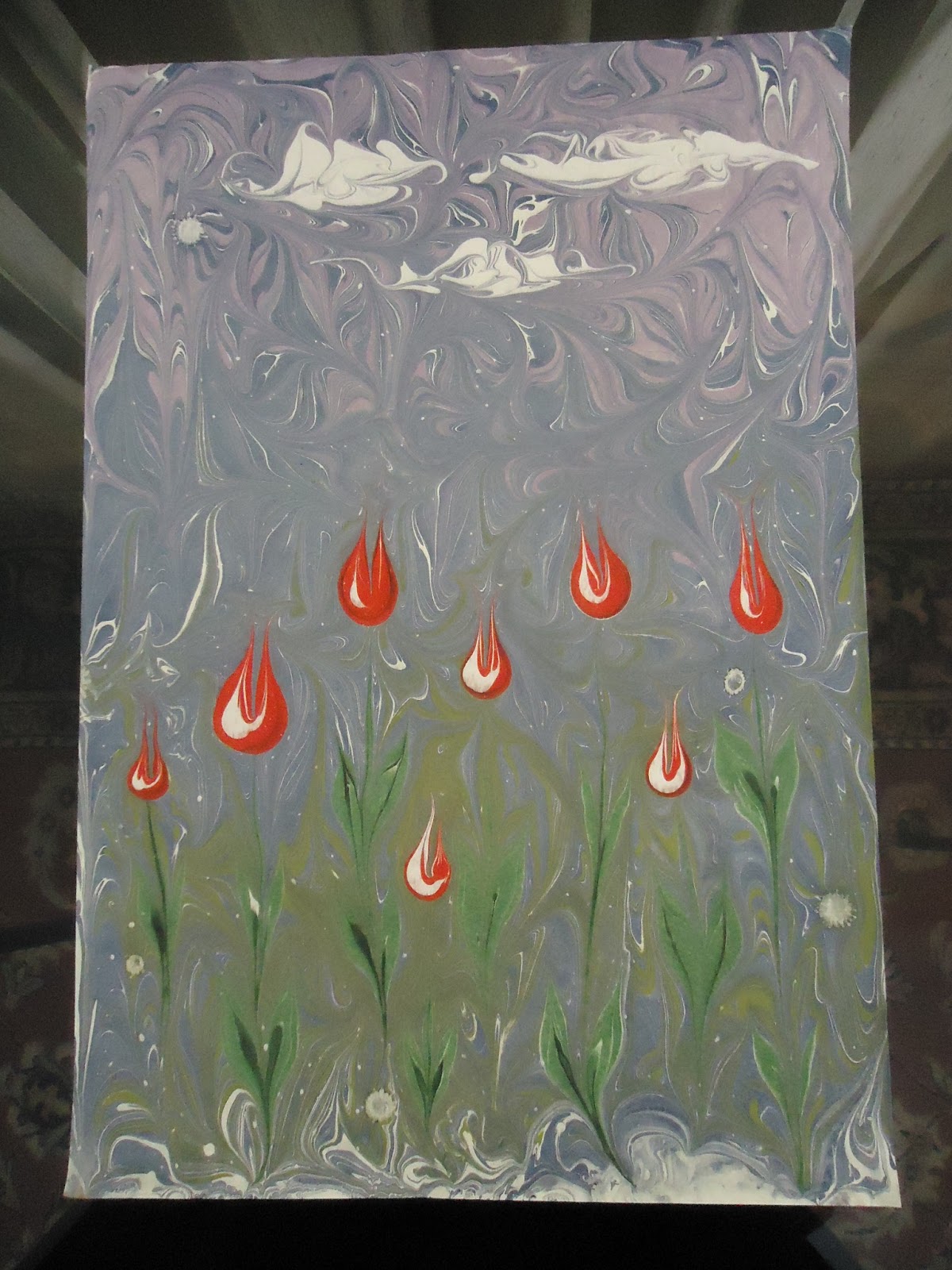
When Amanda and I visited Istanbul I took a class in Ebru, Turkish marbling.  I had arranged for the private lesson via the Internet and had my expectations exceeded, which is a lovely thing.  I spent almost 3 hours there, during which time Amanda was on their computer and was provided with a sandwich while she waited for me.  Betul, my instructor, does beautiful work, and did an excellent job of explaining her process as she demonstrated.  (See her webpage at http://lesartsturcs.com/lessons/marbling_lessons.php) Her method was to demonstrate a pattern and then have me create one.  We focused, as I had requested, on the floral patterns that are characteristic of Turkish marbling.  
This one was done by Betul.  She was very generous to share the demonstration pieces with me.


Both the one above and the one below were done by Betul.  Obviously she has had much more practice than I have had!
What I did learn:
  • She also started with carrageenan base
  • Paints are powdered natural pigments mixed with water
  • Add background with paintbrush-like brushes in stone pattern
  • Gelgit with single stylus (very similar to my initial process already)
  • Add drops of paint using styluses of varying diameters – this is key to the drawing of designs.  Put down small drops and then continue to build using additional drops in center – same or different colors.  Use smaller stylus (diameter of wire) for fine drawing.
  • The drawing techniques themselves I think I can get from books, especially now that I have seen it and practiced.
I only had two disappointments related to my marbling session.  The first is that I completely forgot to take photos documenting the process of creating the designs, although I do have written notes for when I get back stateside and can resume marbling.  The second was that Betul uses, at least for my session, a fairly cheap paper.  I found it interesting that she does not apply mordant to the paper.  I don't know if that is because of qualities in the pigments used or in the paper.  She did make a point of showing me that the pigments she uses begin as powder and, as she said, are natural minerals.
Here in Romania I have Razvan's paper, which is definitely visually appealing, but is very soft.  His paper is made from recycled paper only because he does not have a working beater, required for macerating either rags or plant fibers. The paper works well for computer printing - and we will be using it in the book on which we are collaborating, but does not lend itself to being used for drawing or writing.  I hope Razvan is able to take advantage of material I shared with him about beaters.  He needs a beater to be able to go the next step in making quality paper.